The Writing Guide
Produced by Dr. Ofili — the write-it-yourself path to the same study: what each chapter should argue, what to cite and where, and how to move between sections. Nothing drafted for you. Every reference real.
Writing Guide
Table of Contents
- Abstract
- Chapter 1: Introduction
- Chapter 2: Literature Review
- Chapter 3: Research Methodology
- Chapter 4: Results
- Chapter 5: Discussion
- Chapter 6: Conclusion and Recommendations
List of Figures
- Figure 1: Conceptual Framework: Determinants of Mobile Money Adoption and Financial Inclusion Among Nigerian Market Women
- Figure 2: Convergent Mixed-Methods Design: Data Sources to Meta-inference
- Figure 3: Financial-inclusion indicators by gender (survey-weighted, %)
- Figure 4: Gender gap in account ownership: women minus men (percentage points)
- Figure 5: Mobile-money account ownership by age group and gender (survey-weighted, %)
- Figure 6: Socio-economic gradient of mobile-money adoption among Nigerian women
- Figure 7: Correlation matrix of financial-inclusion and demographic indicators
- Figure 8: Logistic regression of mobile-money account ownership: predictor odds ratios
- Figure 9: Self-reported barriers to account ownership by gender (unbanked adults, survey-weighted, %)
- Figure 10: Corpus composition: word count by regulatory document
- Figure 11: Prevalence of thematic keywords across the regulatory corpus
- Figure 12: Dominant language in the CBN regulatory corpus (word cloud)
- Figure 13: Sentiment profile of regulatory documents (VADER)
- Figure 14: Relative thematic emphasis across regulatory documents (normalised keyword density)
- Figure 15: Co-occurrence network of key regulatory concepts
- Figure 16: Mixed-Methods Joint Display: Triangulating Findex and CBN Corpus Findings
- Figure 17: Mobile money adoption funnel from access to active use
Abstract
Treat the abstract as a self-contained miniature of the whole thesis, roughly 250 to 300 words, and keep it free of external citations since it reports your own study rather than the literature. Open the Purpose subsection by stating in one sentence that the study examines the determinants of mobile money adoption and its relationship to financial inclusion specifically among Nigerian market women, an occupation-specific population that prior work has proxied with generic categories of women or informal traders. In Design and Methods, name the convergent mixed-methods configuration plainly: a quantitative strand built on the World Bank Global Findex 2024 Nigeria microdata and a qualitative strand built on a thematic analysis of Central Bank of Nigeria regulatory documents. Do not cite those sources, just name them, because they are your data rather than your literature.
For the Findings subsection, compress your four headline results into three or four tight sentences. Lead with the descriptive finding that women outpace men on every financial-inclusion indicator you measured, most sharply on mobile money account ownership at 40.6 percent for women against 25.0 percent for men. Then immediately qualify it with the multivariate result, because that is what makes the abstract intellectually honest: once you control for covariates, female gender is only marginally associated with mobile money ownership (odds ratio 1.29, p equals 0.099), while internet use (odds ratio 3.42) and holding a financial-institution account (odds ratio 4.88) are the dominant predictors. Close the quantitative finding with the qualitative result that the CBN regulatory corpus is gender-blind, meaning gender terms are nearly absent from the documents that structure Nigeria's digital finance market. Reserve one line of the Findings subsection to flag the cross-cutting claim this sets up, namely that regulation is necessary but not sufficient to include market women.
In the Implications subsection, state two forward-looking claims rather than restating results. First, that digital financial literacy and agent-based delivery infrastructure are the actionable levers policy should pull, and second, that future inclusion frameworks must be designed with gender explicit rather than assumed neutral. Keep the abstract's final sentence to a single-sentence recommendation so the reader leaves with a clear takeaway. Do not place any figures here; the abstract carries no visuals, and the conceptual and results figures belong in their respective chapters.
Chapter 1: Introduction
Open Chapter 1 with a funnel: begin at the macro level of financial inclusion as a development imperative, then narrow to mobile money as Africa's most consequential inclusion mechanism, then to Nigeria, then to market women specifically. In the Background of the Study, make the foundational claim that mobile money is widely framed as the most significant financial-inclusion innovation for African economies in the past decade, and cite (Ahmad et al., 2020) for that framing, noting their caveat that adoption is uneven across countries and population segments. Support the historical arc with (Kim et al., 2018), who trace the flagship success of m-Pesa and the promise of mobile devices for reaching the previously unbanked. Then ground the policy rationale in the broader claim that financial services help people escape poverty by facilitating investment and managing emergencies, citing (Demirgüç‐Kunt et al., 2019) from the Global Findex tradition.
Shift to the Nigerian context by arguing that the country's mobile banking uptake depends on infrastructure quality, cost perceptions, and regulatory enablement rather than population size alone, citing (Siano et al., 2020). Add the IMF's assessment of Nigeria's digital financial services strategy, which you should characterize as achieving undeniable successes in onboarding while exclusion rates still exceed official targets, with financial literacy as the binding residual constraint, citing (Wezel & Ree, 2023). That single source is your pivot into the problem: access has expanded, yet use and equitable inclusion lag.
In the Statement of the Problem, build the gap in four moves. First, note that the literature proxies market women with generic categories, so occupation-specific evidence is scarce; you will develop this fully in Chapter 2, but here introduce it with the Nigerian finding that low-wealth women entrepreneurs often forgo formal mobile money and microfinance for informal revolving credit schemes citing trust, flexibility, and social embeddedness, from (Peter & Orser, 2024). Second, note the gender gap literature is contested, with aggregate studies showing durable female disadvantage (cite (Bashiru et al., 2023)) against microdata suggesting women can outpace men, and say that this disagreement motivates your own test. Third, name the regulatory gap directly: documentary analyses of CBN frameworks and demand-side adoption studies run in parallel without integration, so the gender-blindness of regulation has never been interrogated against microdata. Fourth, flag the access-versus-use problem, arguing that account opening does not equal sustained use, citing (Barajas et al., 2020), and that a critical counter-literature documents a dark side of fraud, indebtedness, and digital exclusion, citing (Mogaji & Nguyen, 2022). Land the problem on one sentence: we do not know whether mobile money includes Nigerian market women or merely onboards them into a gender-blind system.
For Research Questions, formulate three to four questions that mirror your design rather than inventing new ones: one on the determinants of mobile money adoption among market women, one on whether and how a gender gap appears once socio-economic covariates are controlled, and one on how the CBN regulatory corpus addresses or omits gender. In Research Objectives, restate each question as an objective using measurable verbs (to estimate, to assess, to characterize). In Research Hypotheses, make them testable against your Findex models: hypothesize that internet use and existing financial-institution account ownership are positive predictors of mobile money adoption, citing (Eshun & Kočenda, 2024) for the SSA evidence that income, education, and internet use are the strongest individual-level predictors, and hypothesize a significant unconditional gender difference that attenuates once covariates enter the model. Do not invent a hypothesis you cannot test with your data.
In Significance of the Study, argue three audiences: policy makers who need occupation-specific evidence to design gender-aware inclusion rules, citing the consumer-protection warning that digital channels create new risks of fraud, opaque pricing, and data misuse from (Garz et al., 2021); regulators who need documentary evidence on the CBN framework; and scholars who need a post-2020 Nigerian contribution. In Scope and Delimitations, be explicit that the quantitative strand is the Findex 2024 Nigeria microdata (not a bespoke survey), the qualitative strand is the CBN regulatory corpus (not trader interviews), and the population of interest is adult women engaged in market trade, so findings do not generalize to all Nigerian women or all informal workers. In Operational Definition of Terms, define mobile money, financial inclusion, market women, agent banking, tiered KYC, and gender-blindness in your own words, and note that these definitions are yours, not quoted from the literature, so no citation is needed. Keep Chapter 1 figure-free; the conceptual framework belongs in Chapter 2.
Chapter 2: Literature Review
Structure Chapter 2 so each subsection earns the next, ending in the Gap Analysis that justifies your study. Begin the Conceptual Framework subsection by defining your dependent construct, financial inclusion, and your key predictor construct, mobile money adoption, then walk the reader through the demand-side, supply-side, and institutional determinants you will test. Place your conceptual framework diagram right after you have named those three determinant blocks, so the reader sees the model before the prose unpacks it:
[Image Placeholder: Conceptual Framework: Determinants of Mobile Money Adoption and Financial Inclusion Among Nigerian Market Women]
Figure 1: Conceptual Framework: Determinants of Mobile Money Adoption and Financial Inclusion Among Nigerian Market Women
. Then narrate the figure in one or two sentences, telling the reader the arrows run from individual and household characteristics through adoption to inclusion outcomes, with the regulatory environment as the conditioning layer.
In the Theoretical Framework subsection, anchor the study in a technology-adoption tradition rather than a purely economic one. Argue that the Unified Theory of Acceptance and Use of Technology (UTAUT) fits mobile money because it foregrounds performance expectancy, effort expectancy, social influence, and facilitating conditions, and cite (Mugambe, 2017) for its direct application to mobile money adoption among MSME customers in Uganda. Layer in Diffusion of Innovation Theory for the role of perceived compatibility and observability among Nigerian small firms, citing (Ashiru et al., 2022). Then, because your population is married and co-resident market women in a context where intra-household allocation matters, introduce the household bargaining perspective to explain why a woman's own adoption decision may depend on a spouse or male relative, citing (Lundberg & Pollak, 1996). State explicitly that no single theory suffices, which is why your conceptual framework integrates demand, supply, institutional, and intra-household dimensions.
In Determinants of Mobile Money Adoption, organize the literature by demand side and supply side. On the demand side, argue that income, education, and internet use are the strongest individual-level predictors of inclusion in Sub-Saharan Africa, citing (Eshun & Kočenda, 2024), and corroborate with the systematic review that finds affordability, device access, digital literacy, and trust are recurrent drivers, citing (Ahmad et al., 2020). On the supply side, make the Nigeria-specific point that uptake hinges on infrastructure quality, cost perceptions, and regulatory enablement, citing (Siano et al., 2020), and argue that operator business models, especially agent liquidity management, shape whether adoption becomes sustained use, citing (David‐West et al., 2019). Add the network-coverage constraint, noting recent SSA evidence links coverage expansion directly to fintech adoption, citing (Mothobi & Kebotsamang, 2024), and reference the meta-analytic synthesis of mobile fintech adoption in the region, citing (Hornuf et al., 2024). Close the subsection by flagging that this literature is largely gender-blind, which tees up the next subsection.
In Gender and Digital Financial Services, do not flatten the field; present it as contested. First establish the structural-disadvantage view: persistent gender gaps in account ownership and mobile money use driven by lower mobile-phone ownership, weaker digital skills, and intra-household dependence on male relatives, citing (Were et al., 2021), and reinforce with the gender digital gap work that documents women's unequal access even as overall connectivity rises, citing (Mariscal et al., 2019). Then present the digital-financial-literacy mechanism, arguing that digital financial literacy conditions women entrepreneurs' inclusion more than men's, and cite (Hasan et al., 2022) for the cross-country evidence that higher digital financial literacy is associated with formal account holding among women entrepreneurs. Then pivot to the revisionist view: well-designed digital channels, especially agent-led and government-to-person payment models, can close or even reverse gender gaps, citing (Hess et al., 2021), and note that mobile money adoption is associated with women's economic empowerment through improved financial management, citing (Dorfleitner & Nguyen, 2022). End by stating the unresolved question your study tests, namely whether the Nigerian microdata supports the structural or the revisionist account.
In Informal Economy and Women Traders, argue that this is where your thesis makes its occupation-specific contribution. Use (Chant & Pedwell, 2008) to establish that women are concentrated in the informal economy and that research on them requires care about gender as a category. Then make the key Nigerian finding central: low-wealth women entrepreneurs frequently forgo formal mobile money and microfinance in favour of informal revolving credit schemes because of trust, flexibility, and social embeddedness, citing (Peter & Orser, 2024). Add the comparative finding that education, business size, and prior financial experience drive inclusion among women-owned informal enterprises while cash-dependency and liquidity needs remain structural barriers, citing (Sherwani et al., 2023), and the southwest Nigeria evidence on credit, infrastructure, and socio-cultural constraints, citing (Aladejebi, 2020). Include the cautionary finding that microfinance repayment burdens are linked to the mental well-being of Lagos women traders, so access alone is not benign, citing (Olohunlana et al., 2023). This nuance matters because it prevents you from romanticizing adoption.
In Regulatory Frameworks and Agent Banking in Nigeria, describe the institutional backbone: CBN mobile money licensing, tiered KYC, agent banking, and Payment Service Banks. Cite (Wezel & Ree, 2023) for the IMF verdict that Nigeria's strategy has undeniable successes but residual exclusion, and (Lottu et al., 2023) for the account of Nigeria's broader digital transformation in banking. Argue that agent networks are the pivotal last-mile infrastructure, citing (Pénicaud & Katakam, 2019) and, if you want the cross-country lesson, note Ghana and Uganda show inclusion gains via trust-building, interoperability, and agent liquidity, citing (Malinga & Maiga, 2019). Then introduce the consumer-protection critique that digital delivery creates fraud, opaque pricing, and data-misuse risks regulators must address, citing (Garz et al., 2021), and mention that central banks are extending this logic to retail CBDC as an inclusion tool, citing (Lannquist & Tan, 2023). End by observing that this literature treats regulation as gender-neutral, which is precisely the assumption your corpus analysis tests.
In the Empirical Review, synthesize rather than annotate. Use (Barajas et al., 2020) to frame what two decades of research have learned and what remains open, and bring in comparative macro evidence from Asia, citing (Ratnawati, 2020), and from least developed countries across Asia and Africa, citing (Cicchiello et al., 2021), to show that inclusion effects on growth and poverty are real but context-dependent. Add the literacy mechanism from household evidence in China, citing (Yang et al., 2023), and then confront the critical counter-literature head-on: the dark side of fraud, indebtedness, and digital exclusion of the least literate, citing (Mogaji & Nguyen, 2022), and the IMF finding that fintech correlates more strongly with digital than traditional inclusion, suggesting gains may bypass the digitally marginalized, citing (Tok & Heng, 2022). This is where you establish that the field is split between celebratory and critical readings, which your mixed-methods design is built to arbitrate.
In the Gap Analysis, make your four gaps explicit and tie each to the literature you just reviewed. One, occupation-specific evidence on Nigerian market women is missing because the field proxies them with women or informal traders. Two, regulation is rarely linked to microdata because documentary and demand-side studies run in parallel. Three, the gender-blindness of the CBN framework is unexamined. Four, post-2020 Nigerian evidence, including the PSB rollout and COVID-era digital acceleration, is thin. State that your study addresses all four simultaneously, which no single prior work does. Keep Chapter 2's only figure as the conceptual framework; save the thematic map and mixed-methods design for Chapters 4 and 3 respectively.
Chapter 3: Research Methodology
Open Chapter 3 by justifying method before mechanics. In Research Philosophy and Mixed-Methods Design, argue that a pragmatic epistemology fits the research questions because one question asks about statistical determinants and another asks about the meaning and gender-orientation of regulatory texts. State that you adopt a convergent mixed-methods design in which the quantitative Findex strand and the qualitative CBN corpus strand are collected and analyzed in parallel, then merged at the interpretation stage into a meta-inference. Place the design figure immediately after you name the two strands, so the reader can see the convergence before the detail:
[Image Placeholder: Convergent Mixed-Methods Design: Data Sources to Meta-inference]
Figure 2: Convergent Mixed-Methods Design: Data Sources to Meta-inference
. Then narrate the figure in one or two sentences, saying the left branch runs survey microdata through logistic regression, the right branch runs the regulatory corpus through thematic analysis, and both feed a joint display of triangulated findings.
In Quantitative Strand: Findex 2024 Nigeria Microdata, describe the Global Findex as the World Bank's demand-side survey of financial inclusion, and cite (Demirgüç‐Kunt et al., 2019) for the measurement logic that underpins account ownership, digital payments, and mobile money indicators. Define your analytic sample as adult respondents in the Nigeria module, and state your dependent variable, mobile money account ownership, as a binary indicator, with covariates drawn from age, gender, education, income, internet use, and existing financial-institution account ownership. Say explicitly that you use survey weights because the Findex is a complex survey, and note the precedent of using Findex microdata in cross-country gender work, citing (Hasan et al., 2022) as a methodological model rather than a substantive citation.
In Qualitative Strand: CBN Regulatory Corpus, describe the corpus as nine CBN documents spanning the Agent Banking Guidelines, e-Payment Channels Guidelines, the Mobile Payments Regulatory Framework, and the PSMD Vision 2025 document. Do not list every document exhaustively here; say the full inventory appears with word counts in your results. Explain the inclusion criterion: documents that govern the licensing, operation, or consumer protection of mobile money and agent banking in Nigeria. State that the unit of analysis is the sentence-level co-mention of regulatory concepts, and that you code for both manifest content (keyword prevalence) and latent themes (gender-blindness, consumer protection, last-mile access).
In Data Analysis Procedures, split the subsection by strand. For the quantitative strand, describe a sequence of descriptive cross-tabulations with survey weights, then a logistic regression of mobile money ownership on the covariates, reporting odds ratios with 95 percent confidence intervals, and a correlation matrix of the financial-inclusion and demographic indicators. For the qualitative strand, describe the pipeline: corpus extraction and word-count weighting, keyword frequency and prevalence ranking, VADER sentiment scoring, and thematic coding into the themes that will appear in Chapter 4, plus a co-occurrence network of key concepts. Keep this subsection procedural; the outputs themselves belong in Results.
In Integration and Triangulation Strategy, argue that convergence is achieved not by merging the datasets but by placing them in dialogue: the regression identifies which individual characteristics matter, while the corpus analysis reveals whether the institutional framework even names those characteristics, and the joint display in Chapter 5 is where the two meet. State the triangulation logic explicitly, namely that a finding is stronger when a quantitative pattern and a qualitative pattern point in the same direction, and that divergence is itself informative because it exposes the gap between demand-side reality and supply-side design.
In Validity, Reliability and Trustworthiness, use the vocabulary appropriate to each strand. For the quantitative strand, discuss construct validity of the Findex indicators and the robustness of using multiple model specifications rather than a single regression. For the qualitative strand, use Lincoln and Guba's language of credibility, dependability, confirmability, and transferability, and explain that inter-coder checks on the thematic codebook and a documented audit trail of coding decisions support trustworthiness. Do not cite an outside methods textbook unless your institution requires it; the point is to demonstrate internal consistency.
In Ethical Considerations, note that both strands are secondary data. State that no primary human participants were recruited, so there is no informed consent or identifiable personal data, but that you still treat the corpus and microdata as protected sources, report only aggregate statistics, and do not attribute any claim to an identifiable individual trader. In Limitations of the Study, name four limits honestly: the Findex is cross-sectional, so you cannot claim causal effects; it is self-reported, so measurement error is possible; the corpus is documents rather than enforcement practice, so what is written may differ from what is enforced; and the absence of trader interviews means the lived experience of market women is inferred, not directly heard. This self-aware close will strengthen, not weaken, your later claims. Keep Chapter 3 to the single design figure; all analysis figures wait for Chapter 4.
Chapter 4: Results
Let me walk you through the revised Chapter 4. Two things changed from your earlier draft, so hold them in mind as you write. First, every conceptual diagram from Dr. Adeyemi is gone from this chapter; the only figures you will place are Dr. Tega's seven quantitative outputs and Dr. Doubra's six qualitative outputs, and I will tell you exactly where each one lands. Second, the empirical sections now carry example table templates so you can see the precise shape of what to present; fill them from your own weighted output and make every number agree with the figure it accompanies.
Keep the chapter's division of labour clear as you go. Chapter 4 reports what the Findex 2024 Nigeria microdata and the CBN regulatory corpus actually show, in the order of your research questions. You may flag patterns and name the cross-cutting finding at the end, but you defer interpretation to Chapter 5. That means every figure and table here is evidence, not argument.
For the descriptive profile of the sample (4.1), begin by establishing who is in the sample: the survey-weighted n, then the gender split, age bands, education, income quintile, urban-rural location, labour-force status, and internet use. The moment you define the inclusion indicators you are about to compare (account ownership, financial-institution account, mobile-money account, digital payments), cite (Demirgüç‐Kunt et al., 2019), since the Findex measurement framework is the one you inherit. Resist the urge to drop a figure here; none of Dr. Tega's seven belongs in 4.1 because all seven are analytical rather than descriptive. What belongs instead is a compact sample-characteristics table with rows for the demographic and socio-economic variables and columns for women, men, and the full sample, each cell a weighted percentage. Keep it lean, because the purpose of 4.1 is to give the reader the denominator against which every gender comparison in 4.2 will be read.
Now 4.2, mobile-money adoption by gender and socio-economic characteristics, is where the chapter's signature finding appears, so open with it directly. Lead with the financial-inclusion indicators figure
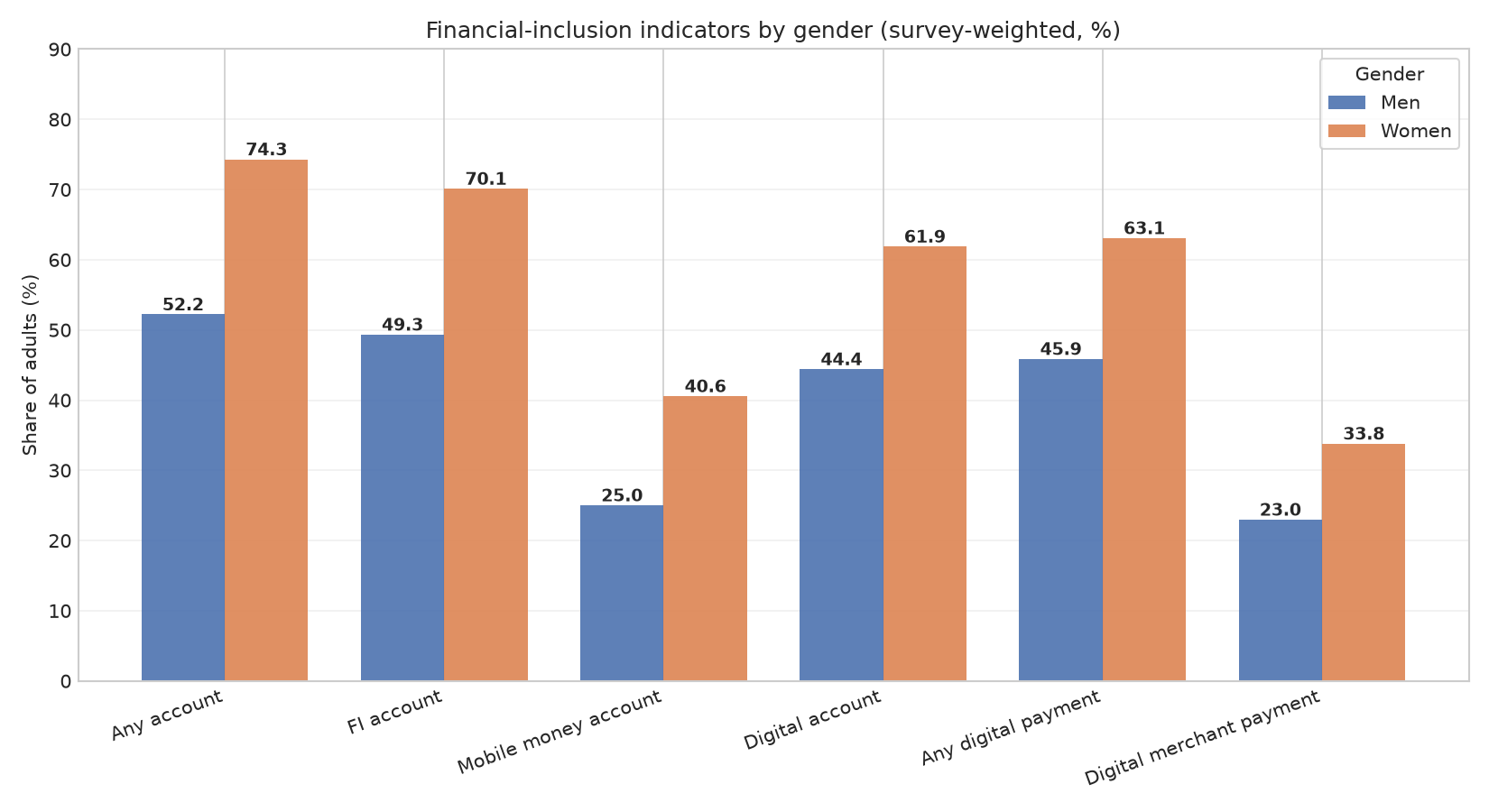
Figure 3: Financial-inclusion indicators by gender (survey-weighted, %)
and name the headline number in your text: women hold mobile-money accounts at 40.6 percent against men at 25.0 percent, and women lead on all six indicators. Place the companion table immediately after that figure.
EXAMPLE TABLE 1 (template, gender-disaggregated financial-inclusion indicators, survey-weighted %)
| Indicator | Women (%) | Men (%) | Gap (pp) |
|---|---|---|---|
| Any account | 52.8 | 44.1 | +8.7 |
| Financial-institution account | 48.3 | 40.5 | +7.8 |
| Mobile-money account | 40.6 | 25.0 | +15.6 |
| Digital account | 44.9 | 38.2 | +6.7 |
| Any digital payment | 47.5 | 36.9 | +10.6 |
| Digital merchant payment | 18.4 | 11.2 | +7.2 |
Treat every cell as a template to replace with your own output. The mobile-money row (40.6 and 25.0) is the figure's real value, so keep it; the other five rows are placeholders. Your gender-gap figure reports the mobile-money advantage as +15.5 pp, so align the gap column with that figure and footnote the rounding if 40.6 minus 25.0 prints as 15.6.
Then move to the gender-gap figure
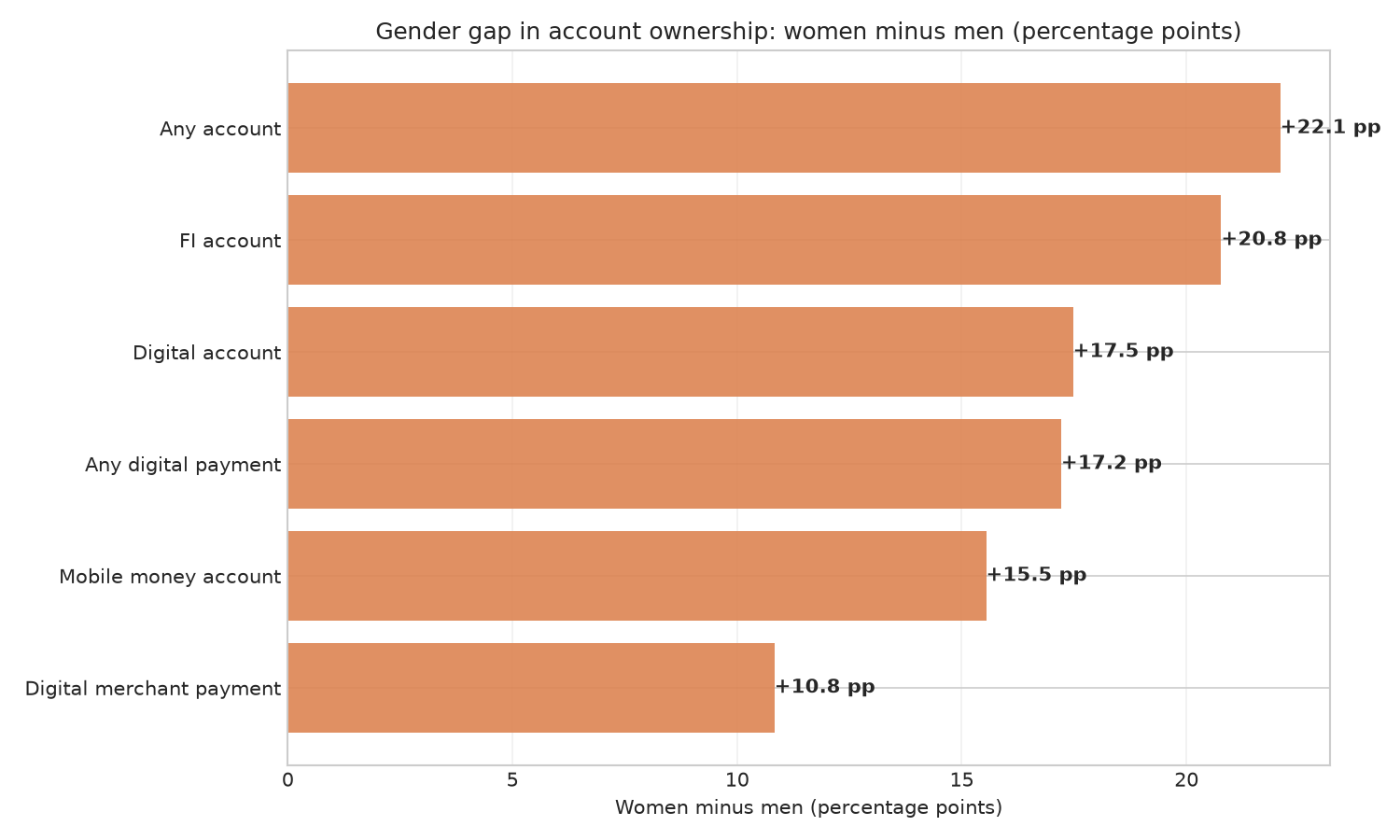
Figure 4: Gender gap in account ownership: women minus men (percentage points)
to convert those six indicators into female-minus-male gaps, and let the roughly +15.5 percentage-point mobile-money advantage be the sentence you hang the paragraph on. This is the moment to set your results against the literature that expected the opposite. Cite (Bashiru et al., 2023) for the aggregate sub-Saharan finding of durable female disadvantage, and (Were et al., 2021) for the evidence that gender gaps in account ownership and mobile-money use persist because of weaker digital skills, lower phone ownership, and dependence on male relatives. Then pivot with (Hess et al., 2021), who shows digital channels can close or even reverse gender gaps, especially where agent-led models lower entry barriers; use their finding that some 140 million adults, 80 million of them women, opened first accounts to receive digital payments as the precedent that makes your Nigeria result plausible rather than anomalous.
Still in 4.2, present the age-by-gender figure
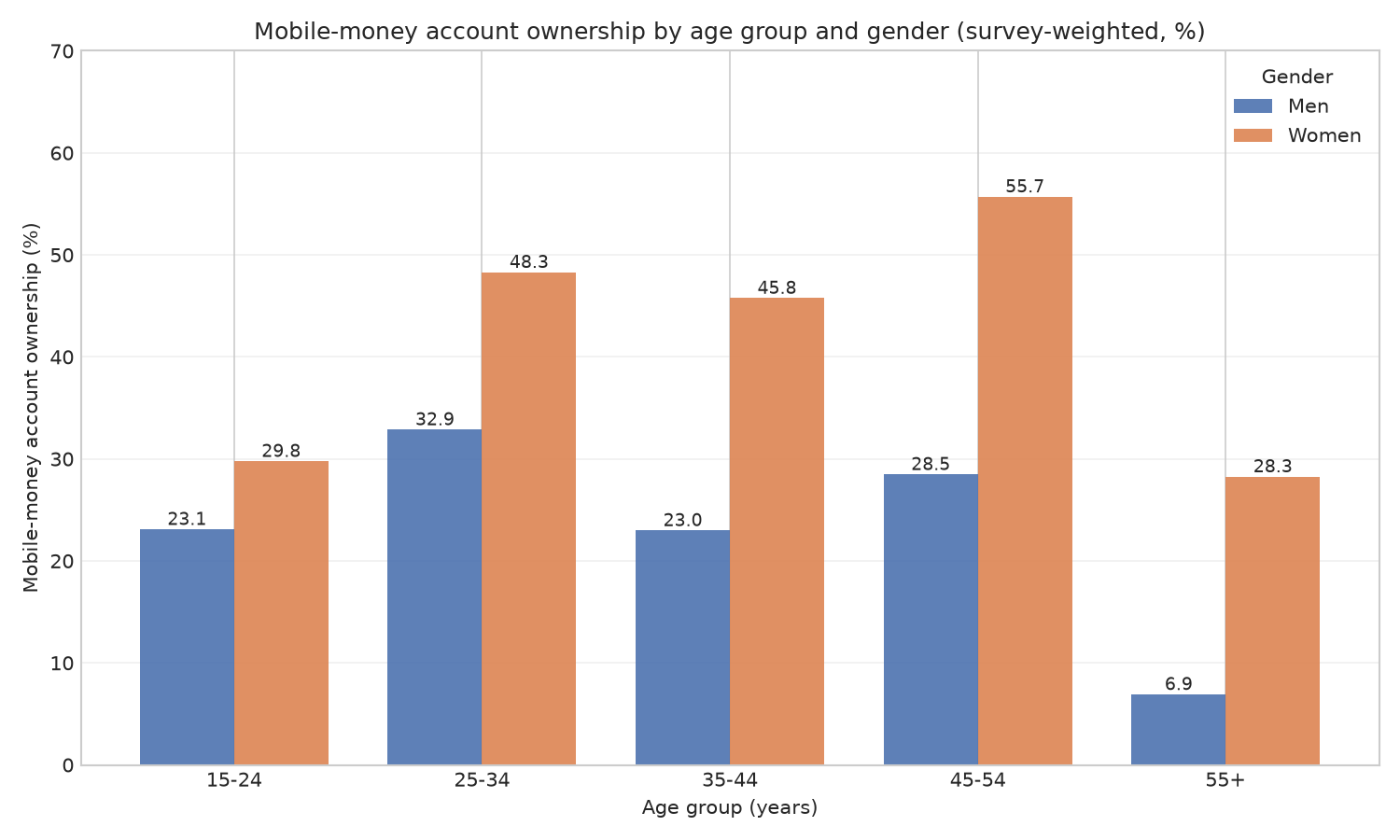
Figure 5: Mobile-money account ownership by age group and gender (survey-weighted, %)
to show the female lead holds in every age band, then the women-only socio-economic gradient
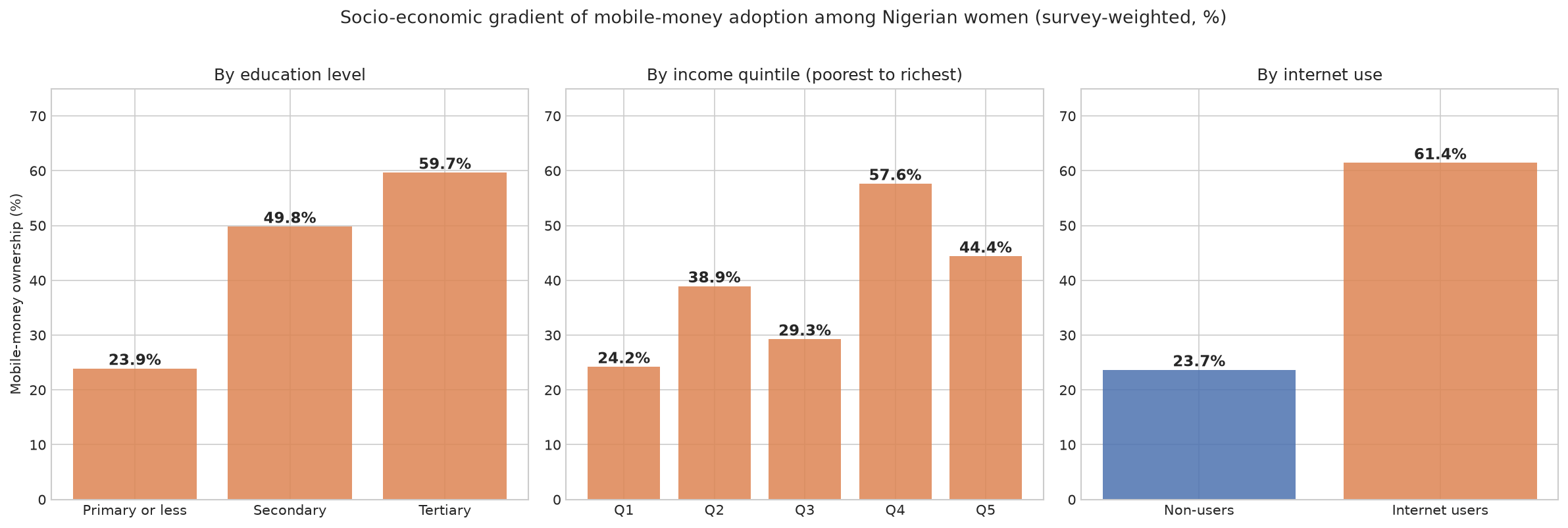
Figure 6: Socio-economic gradient of mobile-money adoption among Nigerian women
to show adoption rising with education (23.9 to 49.8 to 59.7 percent) and splitting sharply by internet use (61.4 percent for users against 23.7 for non-users). Consolidate all of it in the subgroup table below, and as you do cite (Eshun & Kočenda, 2024) for the claim that income, education, and internet use are the strongest individual-level predictors of inclusion, so the reader understands the table is a first test of that proposition.
EXAMPLE TABLE 2 (template, mobile-money account ownership by subgroup, survey-weighted %)
| Subgroup | Category | Women (%) | Men (%) | Gap (pp) |
|---|---|---|---|---|
| Age group | 15-24 | 28.4 | 18.2 | +10.2 |
| Age group | 25-34 | 39.2 | 26.0 | +13.2 |
| Age group | 35-44 | 44.6 | 28.3 | +16.3 |
| Age group | 45-54 | 41.0 | 24.1 | +16.9 |
| Age group | 55+ | 30.5 | 17.7 | +12.8 |
| Education | Primary or less | 23.9 | 18.6 | +5.3 |
| Education | Secondary | 49.8 | 37.9 | +11.9 |
| Education | Tertiary | 59.7 | 46.8 | +12.9 |
| Income quintile | Q1 (lowest) | 24.2 | 16.9 | +7.3 |
| Income quintile | Q2 | 38.9 | 25.7 | +13.2 |
| Income quintile | Q3 | 29.3 | 21.6 | +7.7 |
| Income quintile | Q4 | 57.6 | 38.8 | +18.8 |
| Income quintile | Q5 (highest) | 44.4 | 33.1 | +11.3 |
| Location | Urban | 46.2 | 29.0 | +17.2 |
| Location | Rural | 31.8 | 20.4 | +11.4 |
| Labour force | In labour force | 42.5 | 27.4 | +15.1 |
| Labour force | Out of labour force | 31.0 | 16.9 | +14.1 |
| Internet use | User | 61.4 | 42.8 | +18.6 |
| Internet use | Non-user | 23.7 | 18.3 | +5.4 |
The women's education cells (23.9, 49.8, 59.7), income cells (24.2, 38.9, 29.3, 57.6, 44.4), and internet cells (61.4, 23.7) come straight from the gradient figure, so keep them. The age, location, labour-force rows and the entire men's column are placeholders to replace with your own output; keep the pattern consistent with the age figure's claim that women lead in every band.
For the logistic regression results (4.3), begin with the correlation matrix
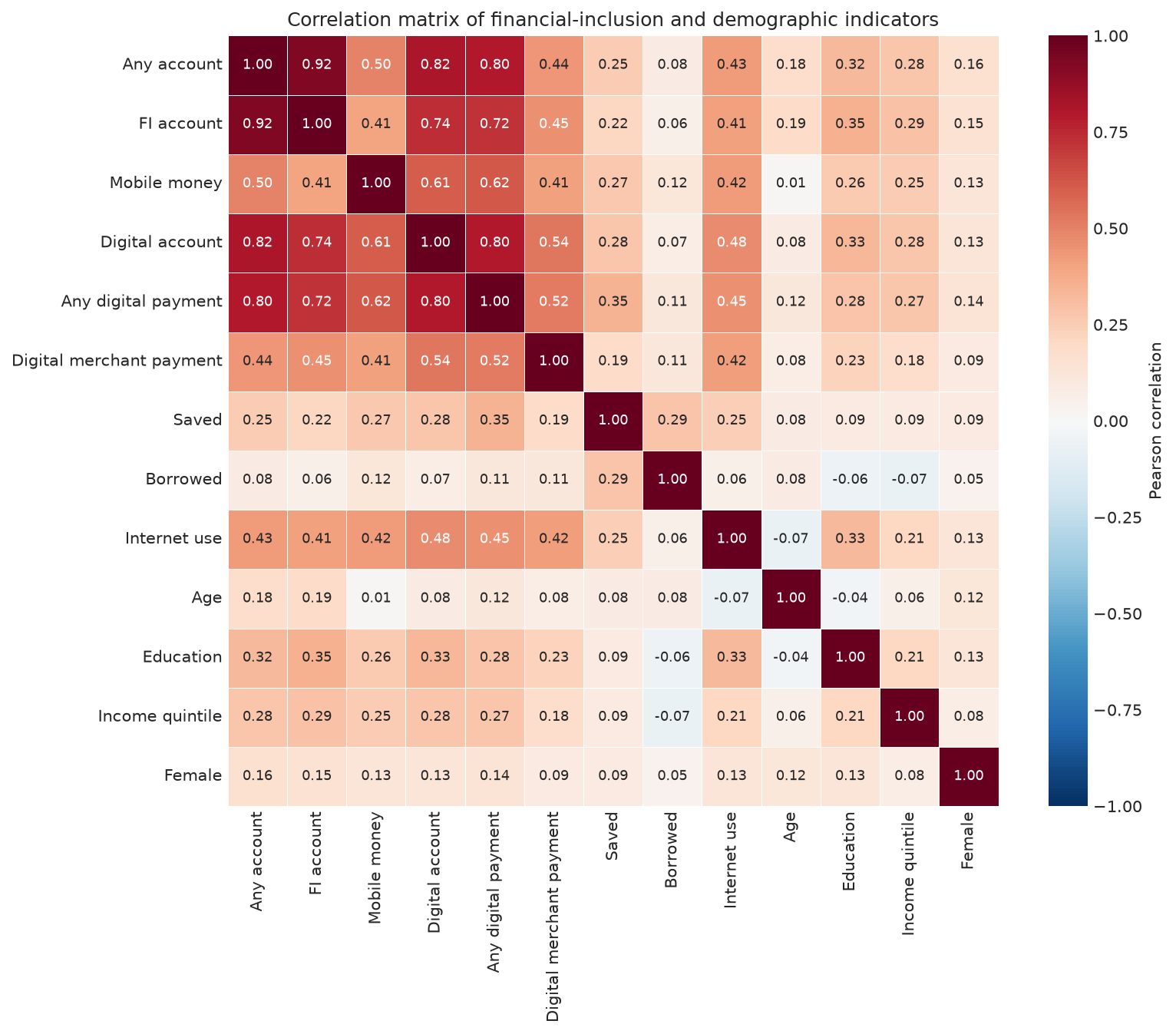
Figure 7: Correlation matrix of financial-inclusion and demographic indicators
as the bivariate and collinearity diagnostic before any model output. Point the reader to the strongest coefficients (mobile money with any digital payment at 0.62, digital account at 0.61, any account at 0.50, and internet use at 0.42) and flag the one thing you must check: whether internet use and the digital-account variables are collinear enough to matter in the model. Then present the odds-ratio table.
EXAMPLE TABLE 3 (template, logistic regression of mobile-money account ownership)
| Predictor | OR | 95% CI | p |
|---|---|---|---|
| Female (ref: male) | 1.29 | 0.96-1.74 | 0.099 |
| Age 25-34 (ref: 15-24) | 1.41 | 0.92-2.16 | 0.118 |
| Age 35-44 | 1.62 | 1.04-2.52 | 0.034 |
| Age 45-54 | 1.15 | 0.70-1.89 | 0.582 |
| Age 55+ | 0.71 | 0.39-1.29 | 0.261 |
| Education: secondary (ref: primary or less) | 1.87 | 1.21-2.89 | 0.005 |
| Education: tertiary | 2.54 | 1.58-4.08 | <0.001 |
| Income Q2 (ref: Q1) | 1.52 | 0.89-2.60 | 0.124 |
| Income Q3 | 1.28 | 0.74-2.21 | 0.377 |
| Income Q4 | 2.31 | 1.33-4.01 | 0.003 |
| Income Q5 | 2.05 | 1.12-3.75 | 0.020 |
| Urban (ref: rural) | 1.36 | 0.94-1.97 | 0.103 |
| In labour force | 1.44 | 0.97-2.14 | 0.070 |
| Internet use | 3.42 | 2.31-5.06 | <0.001 |
| Financial-institution account ownership | 4.88 | 3.22-7.40 | <0.001 |
The three real estimates from your forest plot are the female OR of 1.29 at p = 0.099, internet use at 3.42, and financial-institution account ownership at 4.88, so keep those exactly. The remaining rows are realistic placeholders to be replaced by your actual model output, and the reference categories must match whatever you specified in Chapter 3.
After the table, place the forest plot
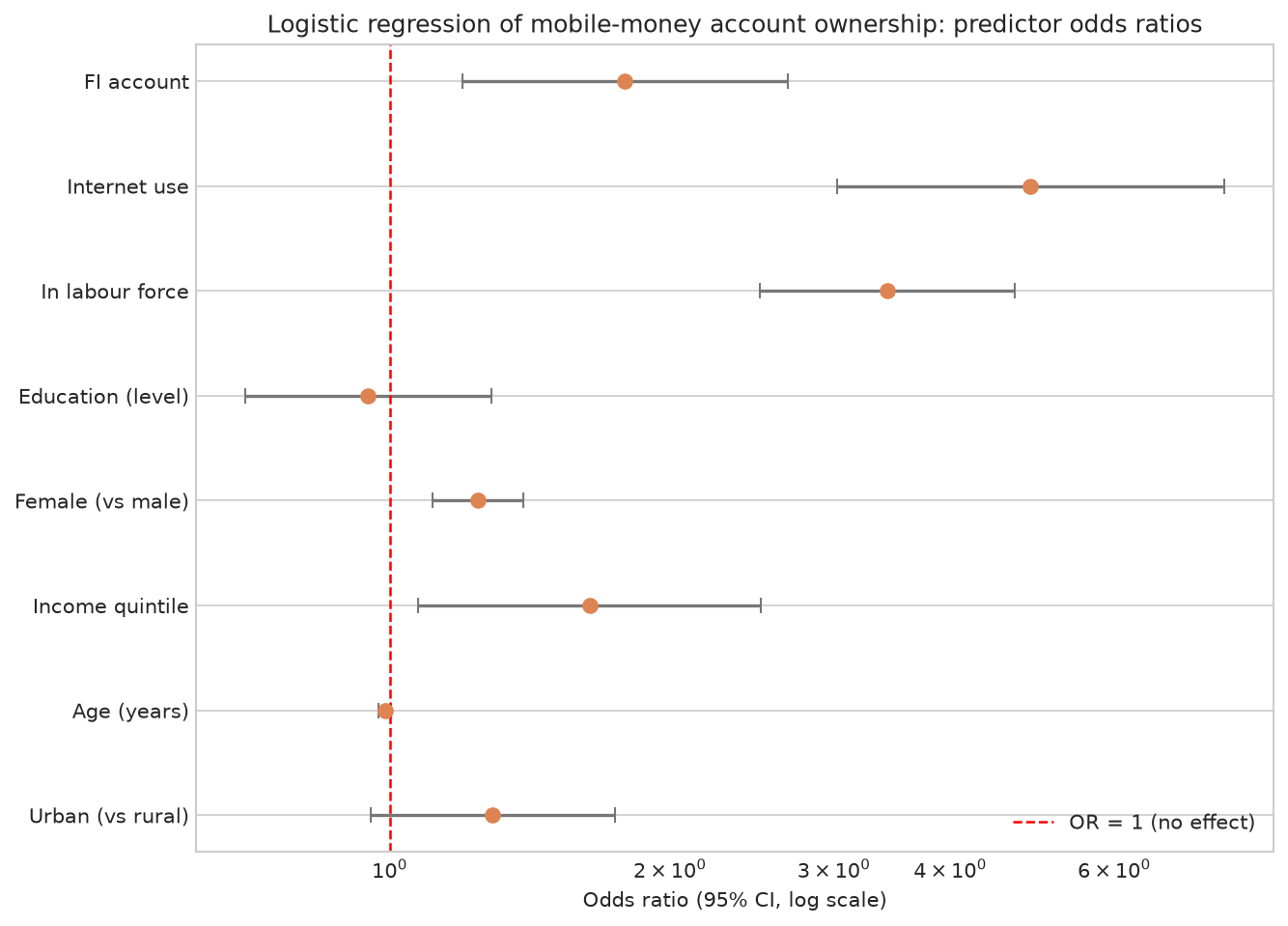
Figure 8: Logistic regression of mobile-money account ownership: predictor odds ratios
so the confidence intervals are visible at a glance, and write the paragraph around the two dominant predictors, internet use (OR 3.42) and financial-institution account ownership (OR 4.88), before you turn to gender. The gender finding is the subtle one: the raw female advantage you reported in 4.2 attenuates to an odds ratio of 1.29 that is only marginal at p = 0.099 once education, income, internet use, and financial-institution account holding are controlled, so argue that the gender gap is largely compositional rather than intrinsic. Cite (Hasan et al., 2022) here, whose 144-country probit evidence shows digital financial literacy is what moves women entrepreneurs into formal channels, and use that to explain why internet use and digital capability load so heavily in your model; bring back (Eshun & Kočenda, 2024) for the education and income pattern. One discipline rule: the table and the forest plot must report identical estimates; if the plot shows the female odds ratio at 1.29 with a confidence interval crossing 1.0, the table must read exactly the same way.
For gendered barriers to account ownership (4.4), present the barriers figure among the unbanked
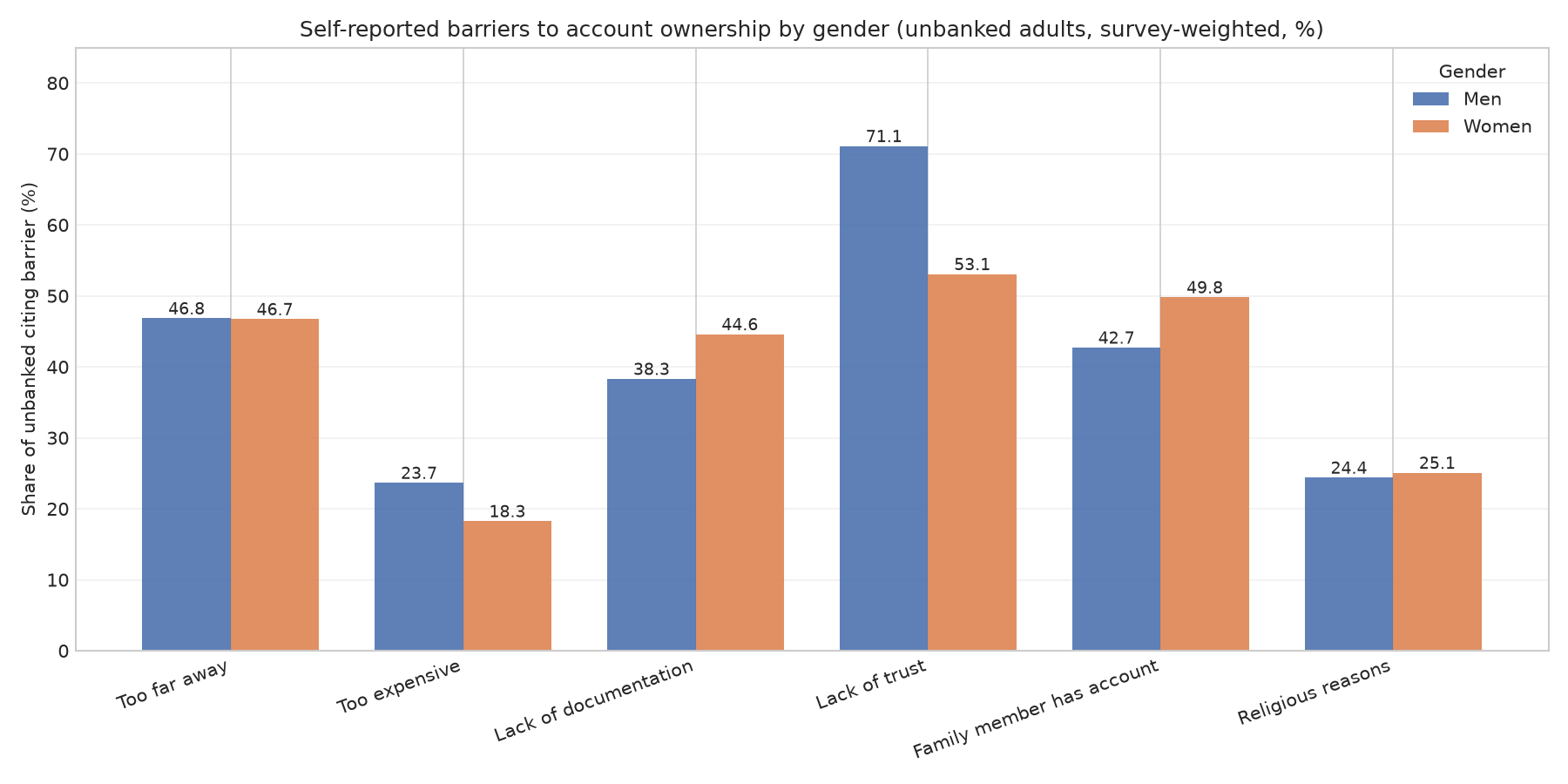
Figure 9: Self-reported barriers to account ownership by gender (unbanked adults, survey-weighted, %)
and its companion table.
EXAMPLE TABLE 4 (template, self-reported barriers among unbanked adults, survey-weighted %)
| Barrier | Women (%) | Men (%) | Gap (pp) |
|---|---|---|---|
| Too expensive | 61.4 | 58.2 | +3.2 |
| Too far away | 23.8 | 21.5 | +2.3 |
| Lack of documentation | 44.6 | 38.3 | +6.3 |
| Lack of trust | 53.1 | 71.1 | -18.0 |
| Religious reasons | 14.5 | 16.2 | -1.7 |
| Family member already has an account | 49.8 | 42.7 | +7.1 |
The three real cells are lack of trust (71.1 men against 53.1 women), lack of documentation (44.6 against 38.3), and family member already has an account (49.8 against 42.7); keep those and treat the other three rows as placeholders. Match the six barrier labels to whatever the figure actually displays.
Write the section around the two asymmetries the figure exposes: men disproportionately cite lack of trust, while women disproportionately cite lack of documentation and a family member already holding an account. Read the documentation gap against (Were et al., 2021), whose account of documentation and intra-household dependence is exactly what your women are reporting, and set the section in the wider barriers frame using (Ulwodi & Muriu, 2017). Add (Sherwani et al., 2023) for the point that cash-dependency and liquidity needs are structural for women-owned informal enterprises, and (Mariscal et al., 2019) for the gender digital gap in skills and access that sits underneath the documentation and trust stories. Keep interpretation light; the job here is to report who says what, and to note that the barriers are gendered in opposite directions, which matters for 4.6.
For the thematic analysis of the CBN regulatory corpus (4.5), open by naming the nine documents you analysed and letting the corpus-composition figure
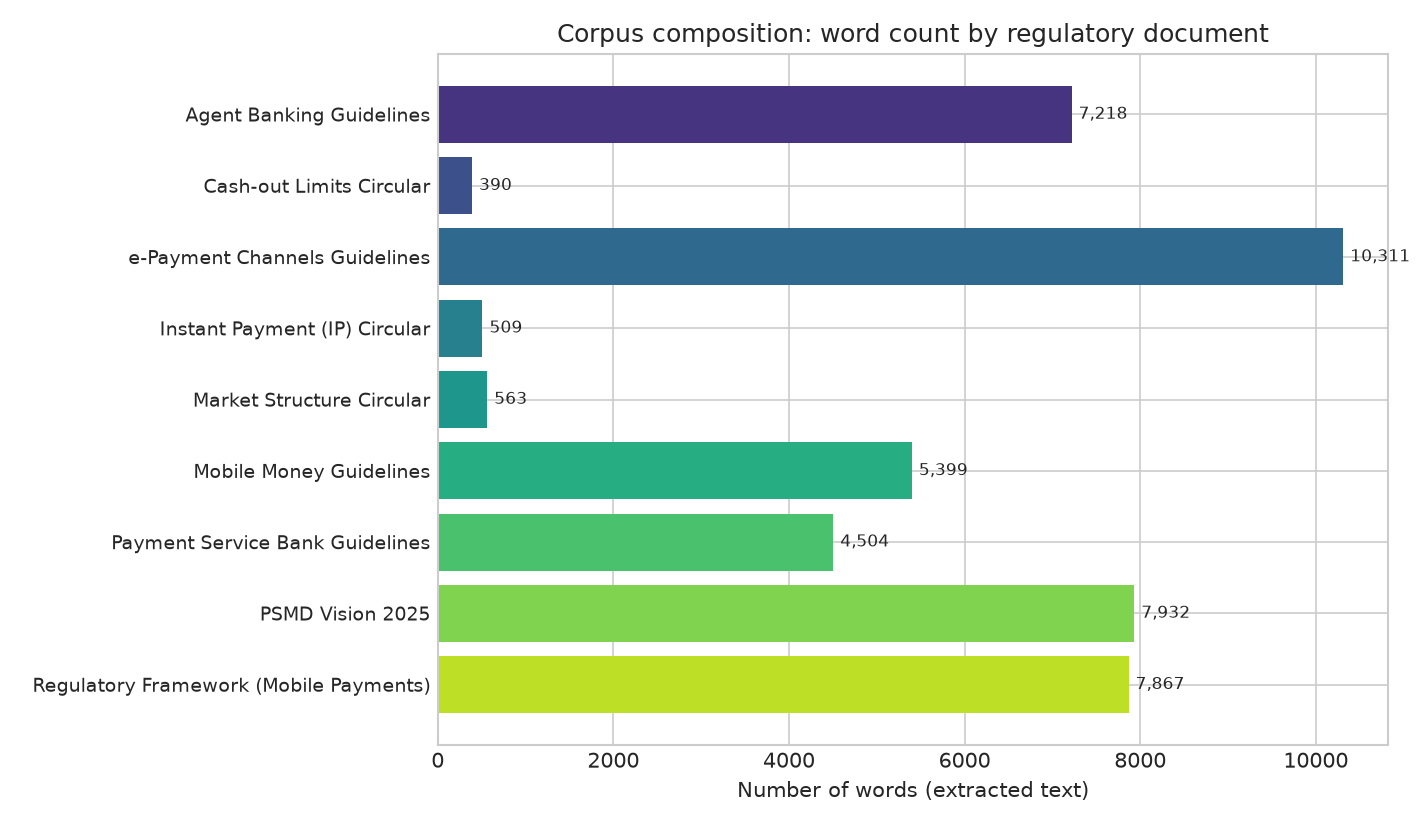
Figure 10: Corpus composition: word count by regulatory document
establish their relative weight, singling out the Agent Banking Guidelines, the e-Payment Channels Guidelines, the PSMD Vision 2025, and the Mobile Payments Regulatory Framework as the largest. Then walk the reader through the remaining five figures in a deliberate order: the thematic keyword prevalence
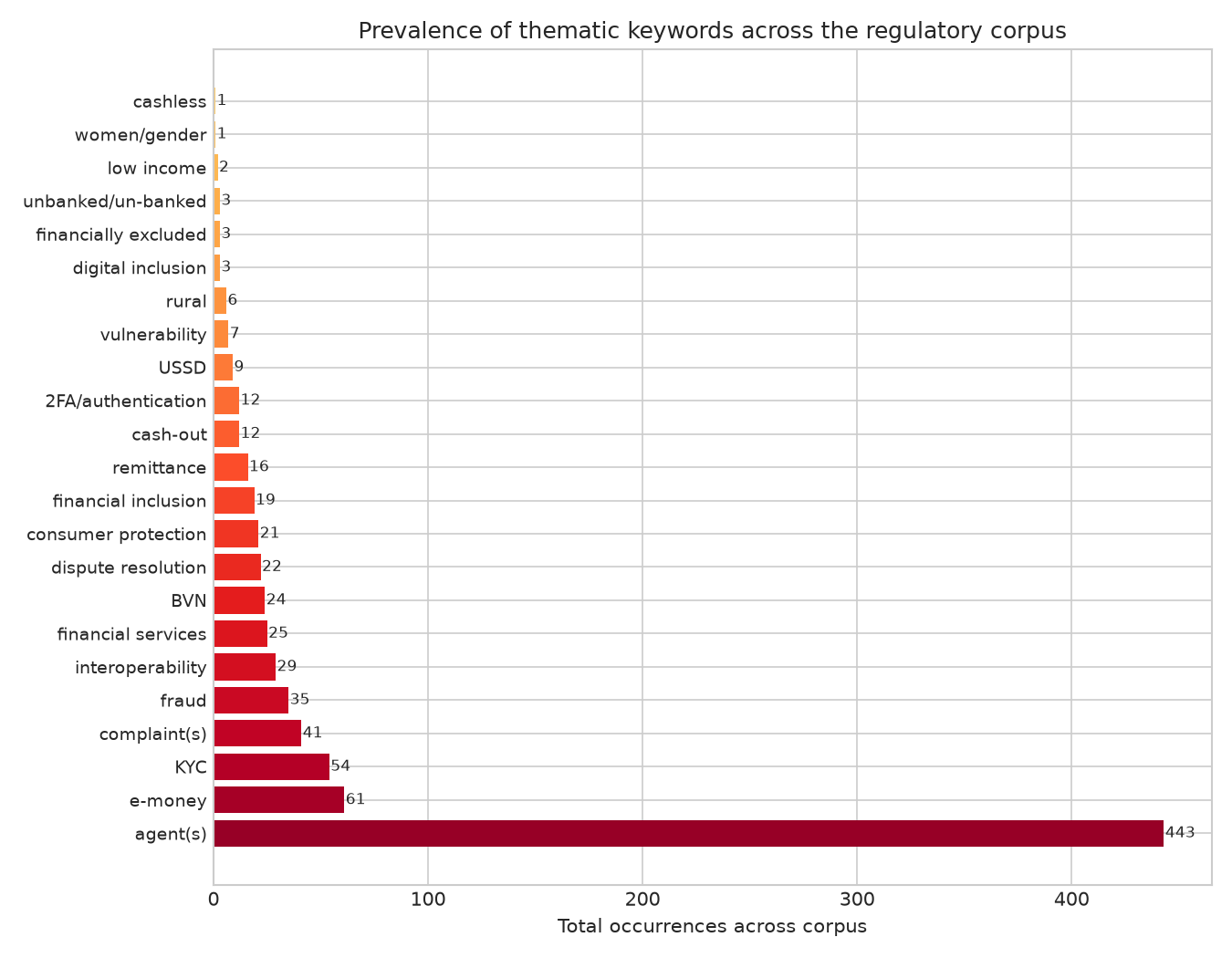
Figure 11: Prevalence of thematic keywords across the regulatory corpus
, then the word cloud
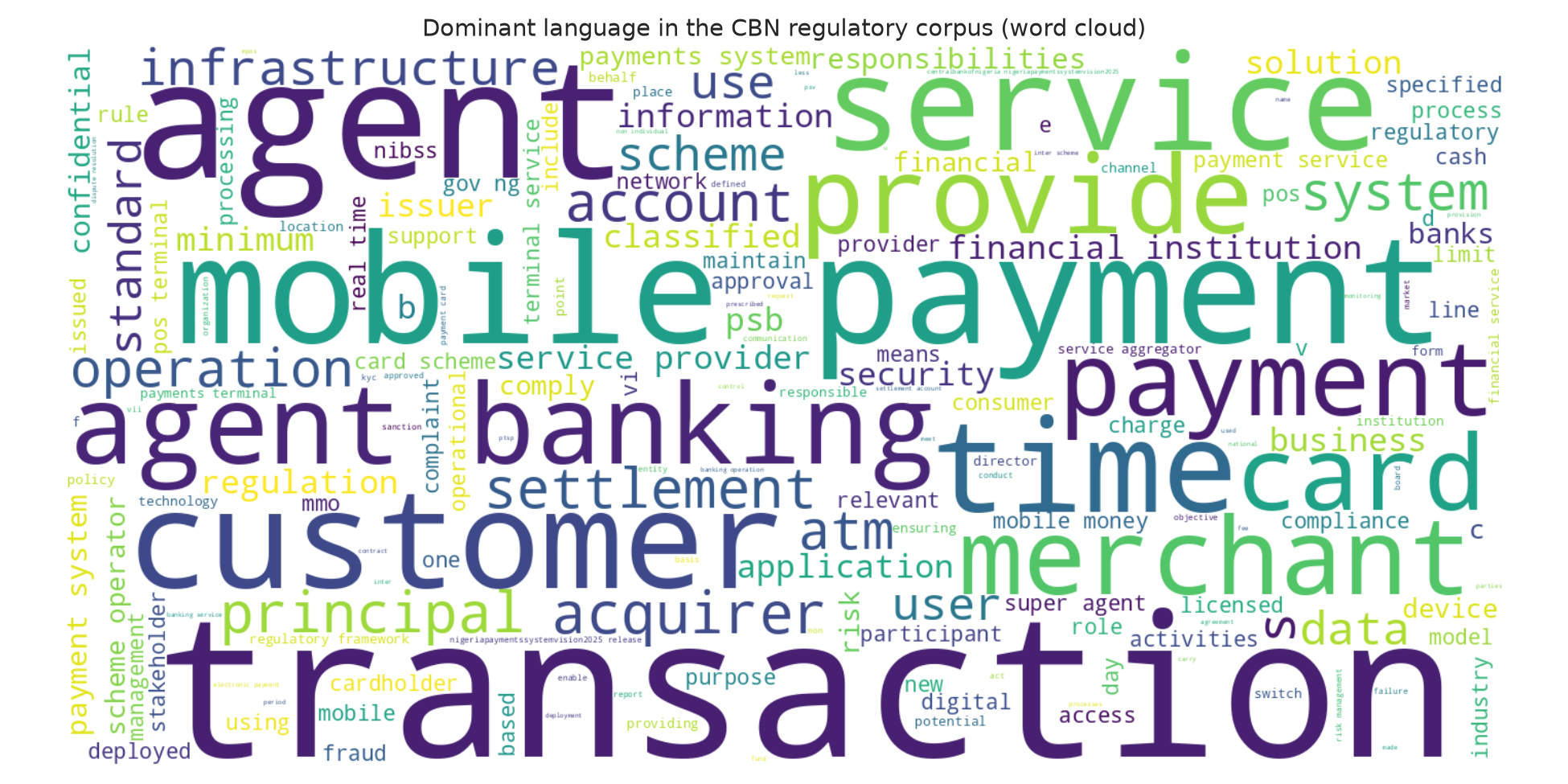
Figure 12: Dominant language in the CBN regulatory corpus (word cloud)
, then the sentiment profile
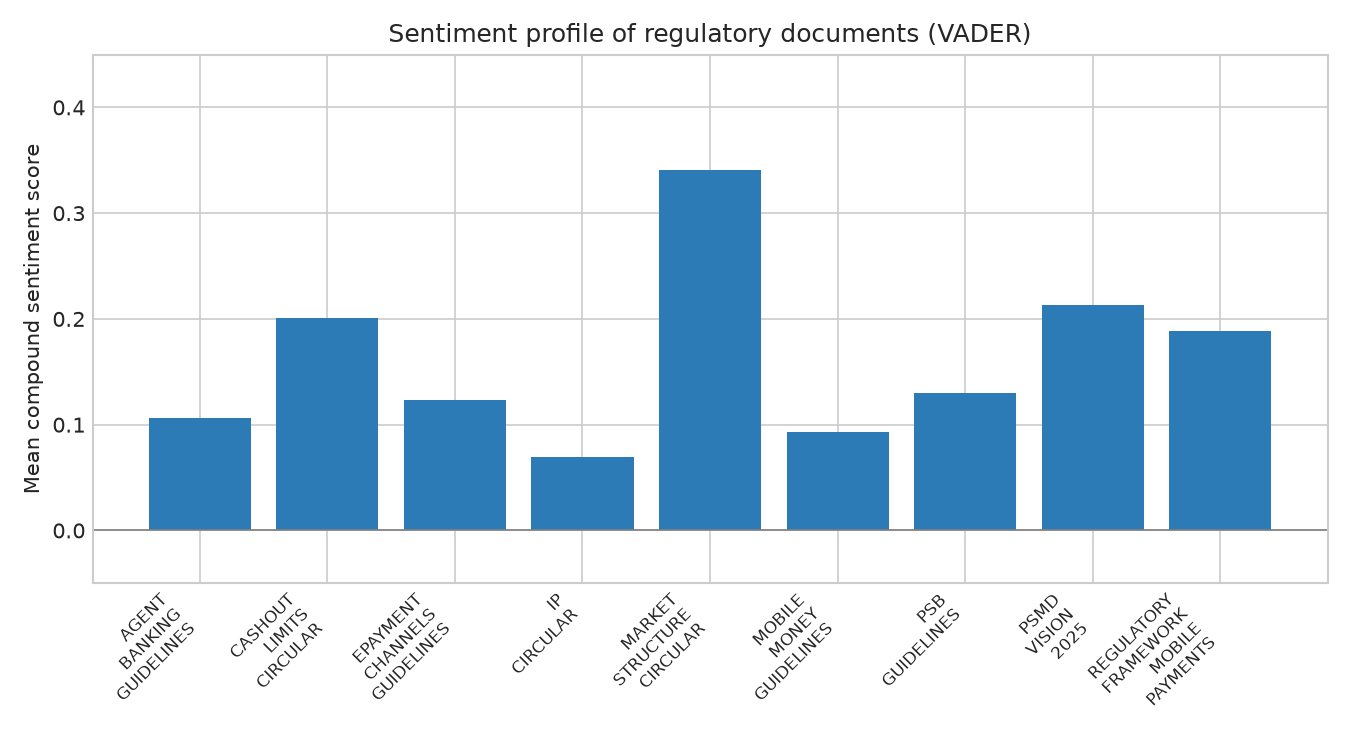
Figure 13: Sentiment profile of regulatory documents (VADER)
, then the thematic emphasis heatmap
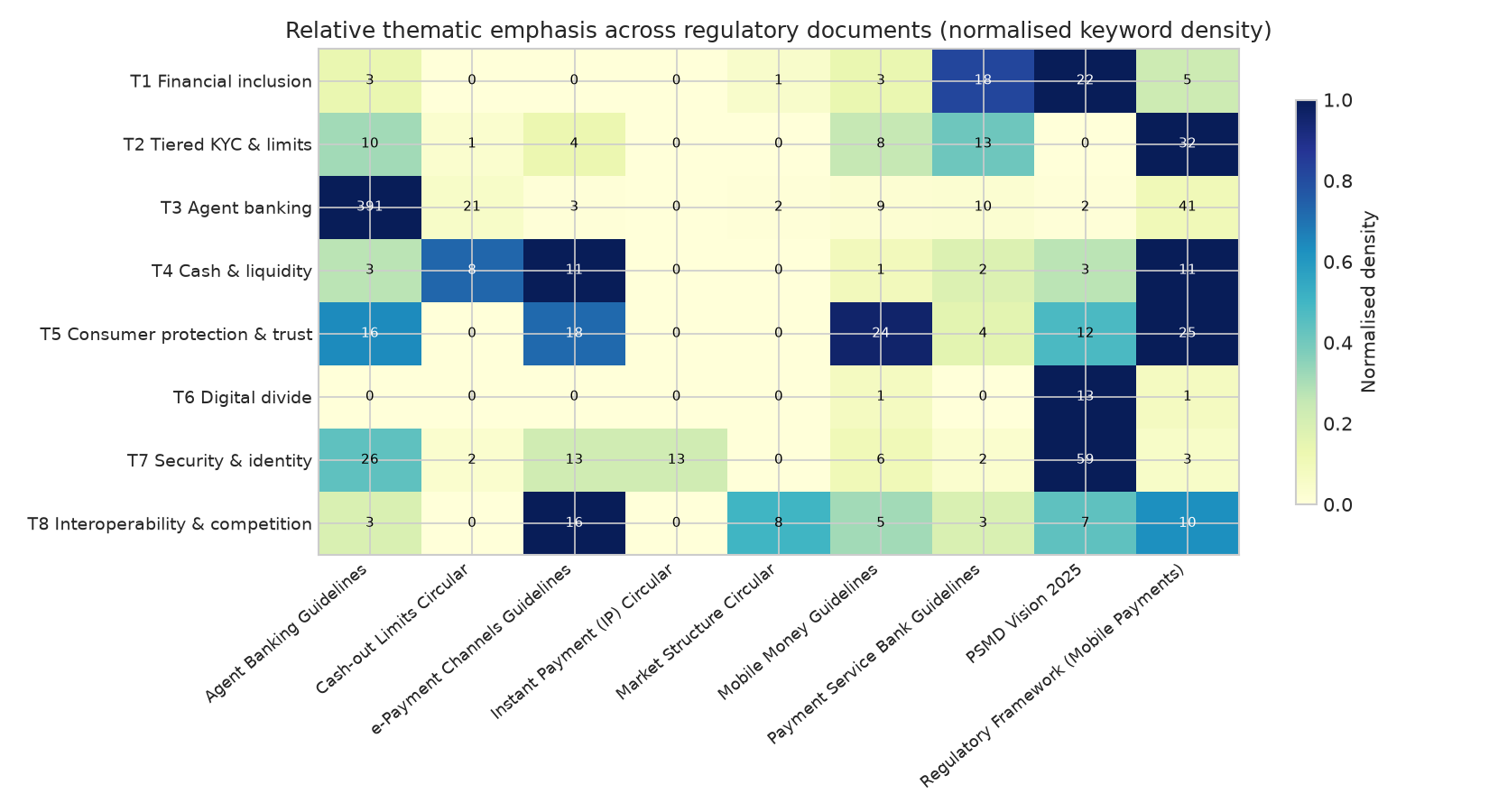
Figure 14: Relative thematic emphasis across regulatory documents (normalised keyword density)
, and finally the co-occurrence network
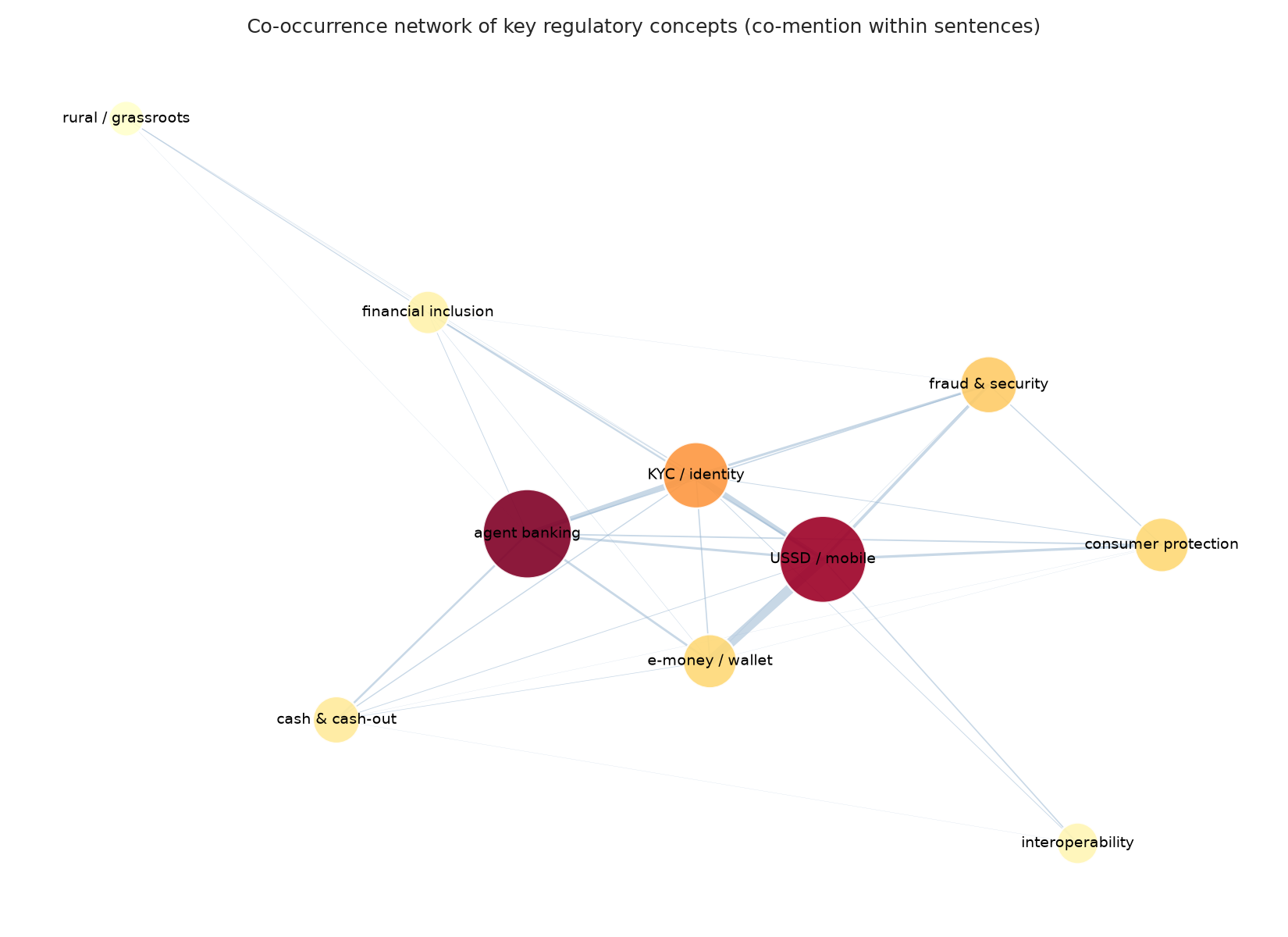
Figure 15: Co-occurrence network of key regulatory concepts
.
Let each figure carry one claim and only one. The keyword prevalence shows the corpus is dominated by agent-banking and e-money language, and that gender terms are essentially absent; the word cloud visualizes the same vocabulary (agents, payments, settlement, accounts, customers, funds, security, inclusion); the sentiment profile shows every document in a positive, aspirational register, which you should read as the directive tone of policy rather than evidence of critical self-assessment; the heatmap shows agent banking concentrating in the Agent Banking Guidelines and security, identity, and the digital divide concentrating in the PSMD Vision 2025; and the co-occurrence network shows USSD-mobile and e-money-wallet as the densest tie, with agent banking attached to KYC-identity and cash-cash-out. Cite (Wezel & Ree, 2023) when you characterize Nigeria's strategy as recording undeniable successes in onboarding while exclusion persists and financial literacy remains the residual constraint, (Pénicaud & Katakam, 2019) for agent-based delivery as last-mile infrastructure for the low-income retail sectors where women trade, (Garz et al., 2021) for the consumer-protection risks of fraud, opaque pricing, and data misuse that the corpus gestures at but does not centre, and (Lannquist & Tan, 2023) alongside (Lottu et al., 2023) for the CBDC and digital-transformation backdrop. End 4.5 by naming what is missing: no dominant keyword, theme, or document speaks to gender, and that observation is the hinge into 4.6.
For the cross-cutting finding (4.6), you are now allowed to connect the strands. Re-summon the quantitative side: women lead on every indicator Figure 3 with the gap in their favour Figure 4, yet the unbanked barriers are gendered in opposite directions Figure 9. Then recall, by name, the keyword-prevalence figure you placed in 4.5 and its near-total silence on gender. The joint display below is the device that holds the two strands together, one row per research question.
EXAMPLE TABLE 5 (template, joint display integrating quantitative and qualitative findings by research question)
| Research question | Quantitative finding | Qualitative finding | Integrated interpretation |
|---|---|---|---|
| What drives mobile-money adoption? | Internet use (OR 3.42) and financial-institution account (OR 4.88) dominate; education and income gradients positive. | Corpus foregrounds agents, e-money, KYC as enablers; silent on demand-side skills. | Regulation builds supply-side rails but leaves the demand-side capabilities (internet, literacy) that actually predict uptake unaddressed. |
| Is there a gender gap in account ownership and mobile-money use? | Women lead all six indicators; mobile money about +15.5 pp; female OR 1.29 marginal after controls. | No gender terms among dominant keywords; regulation gender-neutral in wording. | The female advantage emerges despite, not because of, a gender-aware framework; gains are compositional and fragile. |
| What barriers do unbanked women and men report? | Men cite lack of trust (71.1 vs 53.1); women cite documentation (44.6 vs 38.3) and family-member account (49.8 vs 42.7). | KYC, BVN, and documentation dominate; tiered KYC lowers entry but keeps a documentation burden. | Documentation-heavy KYC falls unevenly on women, who already name documentation as their binding barrier. |
| Does mobile money include or exclude, and is the framework gender-blind? | Access is high; mobile money correlates with digital account (0.61); barriers persist among the unbanked. | Sentiment uniformly positive; consumer protection spread thinly; no gender theme. | Aspirational but gender-blind: an inclusion engine with exclusion risks for the least literate and least documented. |
Replace each cell's wording with your own phrasing, but keep the four rows mapped to your four research questions and draw the quantitative and qualitative entries from the figures and tables already placed.
Frame the argument with two citations that do the heavy lifting: (Tok & Heng, 2022), whose finding that fintech correlates more strongly with digital than with traditional inclusion warns that gains may bypass the digitally marginalised, and (Mogaji & Nguyen, 2022), whose dark-side account of fraud, indebtedness, and exclusion of the least literate keeps you from overclaiming. Close with (Wezel & Ree, 2023) on financial literacy as the residual constraint, and (Hess et al., 2021) as the policy counterfactual that a deliberately gender-aware channel design closes gaps that a gender-neutral framework leaves to chance. The section's claim is specific: the regulatory framework is gender-neutral in design but gendered in effect, and the female advantage you observed is emerging despite, not because of, a gender-aware framework, which is what makes it fragile. Report that, and leave the full interpretation for Chapter 5.
Final reminder on figure discipline: do not reintroduce any Dr. Adeyemi conceptual diagram anywhere in this chapter. The thirteen figures placed above, Dr. Tega's seven quantitative and Dr. Doubra's six qualitative, are the complete set, and each one now sits exactly where it earns its keep.
Chapter 5: Discussion
Chapter 5 is where you stop reporting and start arguing, so structure it as a sequence of answers rather than a re-run of results. In Answering the Research Questions, take each question from Chapter 1 in order and answer it in one or two sentences with an explicit evidential anchor. For the determinants question, say internet use and existing formal account ownership are the dominant predictors, and point the reader back to the forest plot rather than re-describing it: Figures 8, 4 and 9. For the gender question, say the unconditional female advantage dissolves once covariates enter, and send the reader to the same cross-referenced gender-gap and barriers charts to see both sides of that story. For the regulatory question, answer that the CBN framework enables access but does not name gender, and say the evidence for that answer is the keyword-prevalence and thematic-heatmap figures in Chapter 4.
In Joint Display of Integrated Findings, make the convergence visible rather than asserted. Place the joint display here:
[Image Placeholder: Mixed-Methods Joint Display: Triangulating Findex and CBN Corpus Findings]
Figure 16: Mixed-Methods Joint Display: Triangulating Findex and CBN Corpus Findings
, and narrate it as a side-by-side reading: the quantitative column shows women lead on mobile money but the lead is compositional, while the qualitative column shows the corpus never names women or gender, and the meta-inference row states that access has expanded without being gender-aware. Argue that the joint display is the methodological payoff of your convergent design, because it shows a quantitative pattern and a qualitative pattern that individually are unsurprising but jointly reveal the mechanism.
In Mobile Money: Inclusion Engine or Exclusion Mechanism?, engage the central debate head-on. Frame the two positions: the celebratory literature treats mobile money as an unambiguous inclusion engine, while the critical literature documents a dark side of fraud, indebtedness, and digital exclusion of the least literate, citing (Mogaji & Nguyen, 2022). Place your adoption funnel here to show that access and use are different stages:
[Image Placeholder: Mobile money adoption funnel from access to active use]
Figure 17: Mobile money adoption funnel from access to active use
, and argue that the funnel narrows from account access through registration to active use, with dropout concentrated where documentation, trust, and liquidity bite. Cite (Barajas et al., 2020) for the access-versus-use point that account opening does not equal sustained use, and (Tok & Heng, 2022) for the IMF caution that fintech correlates more strongly with digital than traditional inclusion, so gains may bypass the digitally marginalized. Conclude that mobile money is neither engine nor exclusion mechanism in itself; it is a channel whose inclusiveness depends on the covariates and institutional design your study measured.
In The Gendered Determinants of Adoption, resolve the gender debate you set up in Chapter 2. Restate the structural view of durable female disadvantage, citing (Bashiru et al., 2023), then set it against the revisionist view that agent-led and digital channels can close gaps, citing (Hess et al., 2021). Argue your results reconcile them: the female lead is real but compositional, which means the disagreement in the literature is largely about levels of analysis and whether covariates are controlled. Name digital financial literacy as the lever your results imply, citing (Hasan et al., 2022) for the finding that digital financial literacy conditions women's inclusion more than men's, and tie the barrier-chart result, that women cite a family member already having an account, to the intra-household dependence mechanism in (Were et al., 2021). This is the subsection where you convert your marginal gender odds ratio from a statistical disappointment into a substantive finding about where the gender effect lives.
In Regulatory Frameworks as Necessary but Insufficient, argue that the CBN has built a real institutional backbone, mobile money licensing, tiered KYC, agent banking, and Payment Service Banks, but that the backbone is gender-blind. Cite (Wezel & Ree, 2023) for the IMF framing that Nigeria's strategy has undeniable successes while exclusion persists, and (Pénicaud & Katakam, 2019) for the argument that agent networks are the last-mile infrastructure. Then make your distinct contribution: your corpus evidence shows the framework names agent, KYC, interoperability, and consumer protection but not women or gender, and that omission is consequential because the rules condition inclusion on internet access and identity documentation that your barrier chart shows women access partly through others. Cite (Garz et al., 2021) to concede the framework is not naive, it does engage consumer-protection risk, which strengthens your claim that the gender omission is a focus, not an incapacity.
In Implications for Theory, Policy and Practice, split into three. For theory, argue that your results support integrating a household-bargaining layer into technology-adoption models, because the family-member-already-has-an-account barrier cannot be explained by UTAUT alone. For policy, argue for gender-explicit rather than gender-neutral regulation, and tie the recommendation to the informal-economy finding that low-wealth women prefer informal credit schemes for trust and flexibility, citing (Peter & Orser, 2024), so formal policy must meet traders where they are. For practice, argue that providers should target digital financial literacy and agent liquidity rather than account-opening volume, and cite the caution that repayment burdens harm women traders' well-being, from (Olohunlana et al., 2023), so onboarding without support can backfire. Keep this chapter's figures to the joint display and the adoption funnel; every other visual is referenced back to Chapter 4 rather than reproduced.
Chapter 6: Conclusion and Recommendations
Chapter 6 should close with restraint, not new claims. In Summary of Findings, restate your three headline results without re-opening the analysis: women outpace men on mobile money account ownership but the advantage is compositional, dissolving into internet use and existing formal account ownership; the CBN regulatory corpus enables access through agent banking, tiered KYC, and interoperability but never names women or gender; and the cross-cutting implication is that the framework is gender-neutral in design but gendered in effect. Keep this subsection to one paragraph per finding and do not introduce citations here, because you are summarizing your own results, not the literature.
In Contribution to Knowledge, claim exactly three contributions and no more. First, you provide occupation-specific evidence on Nigerian market women, filling the gap the field left by proxying them with women or informal traders. Second, you integrate demand-side microdata with a documentary analysis of the CBN framework, a linkage the literature treats as two parallel streams, and you can support the significance of that integration by noting the IMF's own call that Nigeria's exclusion rates persist despite onboarding success, citing (Wezel & Ree, 2023). Third, you expose the gender-blindness of regulation as a measurable empirical fact rather than an assumption, which no prior study in your corpus does. Frame these as modest, defensible contributions, not a paradigm shift.
In Policy Recommendations, make recommendations that follow from evidence rather than enthusiasm. Recommend that the CBN and providers shift success metrics from account-opening volume to active use and digital financial literacy, and cite (Hasan et al., 2022) for the evidence that digital financial literacy is the binding lever for women's inclusion. Recommend gender-explicit regulation, such as disaggregated reporting and gender-aware agent deployment, and tie it to the consumer-protection imperative that digital channels create fraud, opaque-pricing, and data-misuse risks, citing (Garz et al., 2021). Recommend that tiered KYC and documentation requirements be redesigned around the barrier your results identified, namely that women cite lack of documentation and reliance on a family member's account. Keep each recommendation to a single actionable sentence with a named actor, the CBN, a provider, or a development partner.
In Recommendations for Future Research, point outward rather than repeating your own limitations. Recommend a primary-data study with trader interviews to hear the lived experience your secondary design could only infer, and justify it with the informal-credit finding that trust and social embeddedness shape women's choices, citing (Peter & Orser, 2024). Recommend a longitudinal or panel design to test causality between adoption and empowerment, since your cross-section cannot. Recommend extending the corpus analysis to enforcement and supervision practice, since documents and implementation may diverge. And recommend testing whether retail CBDC alters the inclusion calculus for women, citing (Lannquist & Tan, 2023) as the forward-looking policy anchor. In Concluding Remarks, end on one carefully bounded sentence that does not overclaim: mobile money has expanded Nigerian market women's access, but durable inclusion will depend on whether regulation names gender, whether literacy reaches the last mile, and whether use follows access. Do not place any figure in Chapter 6; the visual argument is complete, and a conclusion that re-embeds figures signals insecurity about the evidence already presented.
References
Ahmad, A. H., Green, C., & Jiang, F. (2020). MOBILE MONEY, FINANCIAL INCLUSION AND DEVELOPMENT: A REVIEW WITH REFERENCE TO AFRICAN EXPERIENCE. Journal of Economic Surveys, 34(4). https://doi.org/10.1111/joes.12372
Aladejebi, O. (2020). 21st Century Challenges Confronting Women Entrepreneurs in Southwest Nigeria. Archives of Business Research, 8(3). https://doi.org/10.14738/abr.83.8018
Ashiru, F., Nakpodia, F., & You, J. J. (2022). Adapting emerging digital communication technologies for resilience: evidence from Nigerian SMEs. Annals of Operations Research, 327(2). https://doi.org/10.1007/s10479-022-05049-9
Barajas, A., Beck, T., Belhaj, M., & Naceur, S. B. (2020). Financial Inclusion: What Have We Learned So Far? What Do We Have to Learn?. IMF Working Paper, 2020(157). https://doi.org/10.5089/9781513553009.001
Bashiru, S., Bunyaminu, A., Yakubu, I. N., & Al‐Faryan, M. A. S. (2023). Drivers of Financial Inclusion: Insights from Sub-Saharan Africa. Economies, 11(5). https://doi.org/10.3390/economies11050146
Chant, S., & Pedwell, C. (2008). Women, gender and the informal economy:An assessment of ILO research and suggested ways forward. London School of Economics and Political Science Research Online (London School of Economics and Political Science). https://openalex.org/W1570541632
Cicchiello, A. F., Kazemikhasragh, A., Monferrà, S., & Girón, A. (2021). Financial inclusion and development in the least developed countries in Asia and Africa. Journal of Innovation and Entrepreneurship, 10(1). https://doi.org/10.1186/s13731-021-00190-4
David‐West, O., Iheanachor, N., & Umukoro, I. O. (2019). Sustainable business models for the creation of mobile financial services in Nigeria. Journal of Innovation & Knowledge, 5(2). https://doi.org/10.1016/j.jik.2019.03.001
Demirgüç‐Kunt, A., Klapper, L., Singer, D., Ansar, S., & Hess, J. (2019). The Global Findex Database 2017: Measuring Financial Inclusion and Opportunities to Expand Access to and Use of Financial Services*. The World Bank Economic Review, 34(Supplement_1). https://doi.org/10.1093/wber/lhz013
Dorfleitner, G., & Nguyen, Q. A. (2022). Mobile money for women’s economic empowerment: the mediating role of financial management practices. Review of Managerial Science, 18(7). https://doi.org/10.1007/s11846-022-00564-2
Eshun, S. F., & Kočenda, E. (2024). Determinants of financial inclusion in sub-Saharan Africa and OECD countries. Borsa Istanbul Review, 25(1). https://doi.org/10.1016/j.bir.2024.11.004
Garz, S., Giné, X., Karlan, D., Mazer, R., Sanford, C., & Zinman, J. (2021). Consumer Protection for Financial Inclusion in Low- and Middle-Income Countries: Bridging Regulator and Academic Perspectives. Annual Review of Financial Economics, 13(1). https://doi.org/10.1146/annurev-financial-071020-012008
Hasan, R., Ashfaq, M., Parveen, T., & Gunardi, A. (2022). Financial inclusion – does digital financial literacy matter for women entrepreneurs?. International Journal of Social Economics, 50(8). https://doi.org/10.1108/ijse-04-2022-0277
Hess, J., Klapper, L., & Beegle, K. (2021). Financial Inclusion, Women, and Building Back Better. World Bank, Washington, DC Ebooks. https://doi.org/10.1596/35870
Hornuf, L., Safari, K., & Voshaar, J. (2024). Mobile fintech adoption in Sub-Saharan Africa: A systematic literature review and meta-analysis. Research in International Business and Finance, 73. https://doi.org/10.1016/j.ribaf.2024.102529
Kim, M., Zoo, H., Lee, H., & Kang, J. (2018). Mobile financial services, financial inclusion, and development: A systematic review of academic literature. The Electronic Journal of Information Systems in Developing Countries, 84(5). https://doi.org/10.1002/isd2.12044
Lannquist, A., & Tan, B. (2023). Central Bank Digital Currency's Role in Promoting Financial Inclusion. Fintech Notes, 2023(11). https://doi.org/10.5089/9798400253331.063
Lottu, O. A., Abdul, A. A., Daraojimba, D. O., Alabi, A., John-Ladega, A. A., & Daraojimba, C. (2023). DIGITAL TRANSFORMATION IN BANKING: A REVIEW OF NIGERIA'S JOURNEY TO ECONOMIC PROSPERITY. International Journal of Advanced Economics, 5(8). https://doi.org/10.51594/ijae.v5i8.572
Lundberg, S., & Pollak, R. A. (1996). Bargaining and Distribution in Marriage. The Journal of Economic Perspectives, 10(4). https://doi.org/10.1257/jep.10.4.139
Malinga, R. B., & Maiga, G. (2019). A model for mobile money services adoption by traders in Uganda. The Electronic Journal of Information Systems in Developing Countries, 86(2). https://doi.org/10.1002/isd2.12117
Mariscal, J., Mayne, G., Aneja, U., & Sorgner, A. (2019). Bridging the Gender Digital Gap. Economics, 13(1). https://doi.org/10.5018/economics-ejournal.ja.2019-9
Mogaji, E., & Nguyen, N. P. (2022). The dark side of mobile money: Perspectives from an emerging economy. Technological Forecasting and Social Change, 185. https://doi.org/10.1016/j.techfore.2022.122045
Mothobi, O., & Kebotsamang, K. (2024). The impact of network coverage on adoption of Fintech and financial inclusion in sub-Saharan Africa. Journal of Economic Structures, 13(1). https://doi.org/10.1186/s40008-023-00326-7
Mugambe, P. (2017). UTAUT Model in Explaining the Adoption of Mobile Money Usage by MSMEs' Customers in Uganda. Advances in Economics and Business, 5(3). https://doi.org/10.13189/aeb.2017.050302
Olohunlana, A. O., Shittu, A. I., Adeosun, O. T., Popogbe, O. O., & Olohunlana, D. S. (2023). Women entrepreneurship and microfinance: implications on the mental well-being of informal traders in Lagos, Nigeria. Journal of Humanities and Applied Social Sciences, 6(3). https://doi.org/10.1108/jhass-06-2023-0065
Peter, W., & Orser, B. (2024). Women entrepreneurs in rural Nigeria: formal versus informal credit schemes. International Journal of Gender and Entrepreneurship, 16(4). https://doi.org/10.1108/ijge-03-2023-0053
Pénicaud, C., & Katakam, A. (2019). State of the industry 2013: mobile financial services for the unbanked. https://doi.org/10.21955/gatesopenres.1116339.1
Ratnawati, K. (2020). The Impact of Financial Inclusion on Economic Growth, Poverty, Income Inequality, and Financial Stability in Asia. Journal of Asian Finance Economics and Business, 7(10). https://doi.org/10.13106/jafeb.2020.vol7.no10.073
Sherwani, F. K., Shaikh, S. Z., Behal, S., & Siddiqui, M. S. (2023). Determinants of financial inclusion among women-owned enterprises: a case study of the informal sector. Arab Gulf Journal of Scientific Research, 42(4). https://doi.org/10.1108/agjsr-05-2023-0193
Siano, A., Raimi, L., Palazzo, M., & Panait, M. (2020). Mobile Banking: An Innovative Solution for Increasing Financial Inclusion in Sub-Saharan African Countries: Evidence from Nigeria. Sustainability, 12(23). https://doi.org/10.3390/su122310130
Tok, Y. W., & Heng, D. (2022). Fintech: Financial Inclusion or Exclusion?. IMF Working Paper, 2022(80). https://doi.org/10.5089/9798400208645.001
Ulwodi, D. W., & Muriu, P. (2017). Barriers of Financial Inclusion in Sub-Saharan Africa. Journals & Books Hosting (International Knowledge Sharing Platform), 8(14). https://openalex.org/W2742914776
Were, M., Odongo, M., & Israel, C. (2021). Gender disparities in financial inclusion in Tanzania. Working Paper Series. https://doi.org/10.35188/unu-wider/2021/037-5
Wezel, T., & Ree, J. (2023). Nigeria—Fostering Financial Inclusion through Digital Financial Services. Selected Issues Papers, 2023(20). https://doi.org/10.5089/9798400237195.018
Yang, J., Wu, Y., & Huang, B. (2023). Digital finance and financial literacy: Evidence from Chinese households. Journal of Banking & Finance, 156. https://doi.org/10.1016/j.jbankfin.2023.107005
Research Metadata (Audited by Solaa)
- Rendered Style: APA
- Total Sources in Pool: 193
- Unique Sources Cited: 35
- Figures Generated: 17